
About New Zealand
New Zealand is the land of fire and ice.
Located in the remote South Pacific Ocean, New Zealand is a land of mighty mountains, rushing rivers, spectacular volcanoes and bubbling geysers. Its nearest neighbour is Australia, over 1,600 kilometres away.
New Zealand consists of two main islands stretching 1,770 kilometres north to south, and several smaller ones offshore. It has a total area of 267,710 square kilometres, making it slightly bigger than Britain and similar in size to Japan.
The country's spectacular landscape is the result of its location in the Pacific Ocean's Ring of Fire (an area in the Pacific where lots of earthquakes and volcanic eruptions occur).
New Zealand combines the fiords of Norway, the mountain lakes and snow-capped peaks of Switzerland, the geysers of Iceland, the old volcanic cones of Hawaii, the moors of Scotland, and the soft green countryside of England, while maintaining an individuality of its own. Scenically, as well as in flora and fauna, it is very different from Australia.
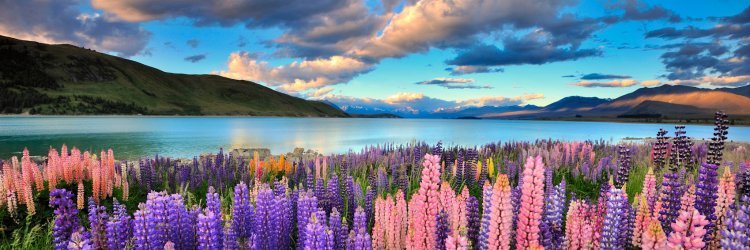
The South Island has the dramatic Southern Alps, as well as fiords, icy glaciers, alpine lakes and large coastal grassy plains, ancient rainforests and wild, rugged beaches. It is dominated by huge, jagged mountain chains, precipices, waterfalls, glaciers, breathtaking highland lakes, and deep coastal fiords.
The North Island boasts great lakes, pristine beaches and bays, rich farming land, mountain ranges with thick forests and huge volcanic mountains. It has over 20 active volcanoes, hot springs, geysers, and mud pools, especially around the town of Rotorua in the north-centre of the island. The North Island is subtropical, with many fine harbours and inlets, and is a land of ferny plateaus, thick bush, volcanic cones, hot springs and geysers.
New Zealand is the most southerly and remote of all the South Pacific nations. For millions of years, it was an untouched wilderness and was settled by humans less than 1,000 years ago.
The ancestors of the Maori arrived around 1200 CE by canoe from Polynesia. These first inhabitants survived largely by fishing, growing vegetables and hunting animals. Maori people lived in tribal groups and used warfare as a way of settling disputes. Maori people call New Zealand Aotearoa, 'Land of the Long White Cloud'.
In 1642, the Dutch explorer Abel Tasman was the first European to sight New Zealand. A hundred years later the British explorer James Cook claimed the country for Britain. Europeans began to arrive from the late 1700s onwards. Sealers and whalers set up bases along the coast, and the flax and timber export industries grew.
In 1839, William Hobson was sent by the British Government to establish a colony in New Zealand by making a treaty with the Maori. In 1840 the treaty was signed at Waitangi in the Bay of Islands.
Since the establishment of British sovereignty the main stream of settlement has come from England. Landmarks have been created largely by immigrants and technologies brought directly from Europe.
Today New Zealand is a young, forward-thinking country of over five million people. It has had a parliamentary democracy for more than 100 years. In 1893, it was one of the first countries to allow women to vote. The country was one of the first in the world to create laws for old-age pensions, minimum wages, and child health services. It is one of the wealthiest and most progressive countries in the world - the model of the 'welfare state'.
New Zealand enjoys a 'clean and green' image. Wherever you are in New Zealand, nature is never very far away, and often it has a dramatic, wild quality. New Zealanders have responded to this by developing a range of 'extreme' outdoor pursuits, such as bungee-jumping, achieving pleasure in a death-defying 'adrenaline rush'.